
Set on a fully fortified limestone island linked to the mainland by a bridge, Gallipoli is one of the most photogenic towns in Salento. Its name comes from the ancient Greek Kalè Polis, “the beautiful city” — a name it still wears very well today, with its whitewashed lanes, ramparts lashed by the Ionian Sea and baroque cathedral.
Between a fortified old town, a fish market that is buzzing from dawn and some of the most celebrated beaches in Puglia, here is everything you need to know to visit Gallipoli without stopping at the postcard view.
QUICK ANSWER
- Top sights: the historic centre on its fortified island, the Castello Angioino-Aragonese, the Cattedrale di Sant’Agata and the Fontana Greca.
- Recommended time: 2 to 3 hours for the essentials, half a day to a full day with the beach and the fish market.
- Best time to visit: May-June and September for pleasant weather; July-August are very lively and very busy.
- Access: the historic centre is a ZTL zone; park before the bridge, at the Via Venezia or Porto car parks.
Contents
Gallipoli in a few words
Gallipoli is a coastal town in Salento, in the province of Lecce, whose historic centre occupies a fully fortified limestone island, linked to the new town by a 17th-century bridge. Founded by the Greeks under the name Kalè Polis (“the beautiful city”), it later came under Roman, Byzantine, Norman and then Spanish rule, each leaving its mark on the architecture of the old centre.
From the 15th to the 19th century, the port of Gallipoli became one of the busiest in the Mediterranean for exporting lampante olive oil, used for street lighting across Europe. Part of this history can still be visited today in the frantoi ipogei, ancient oil mills carved into the rock beneath the palaces of the historic centre.
What to see in Gallipoli: the must-sees
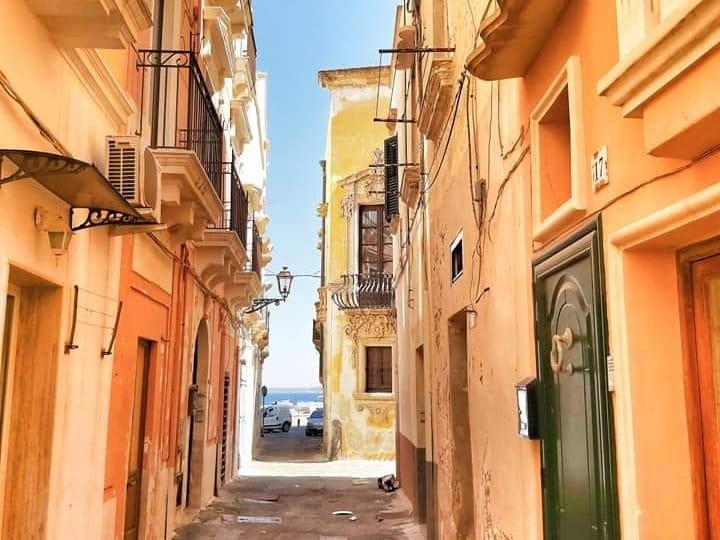
The historic centre can be explored on foot in a few hours: narrow lanes, flower-filled balconies and views of the Ionian Sea at almost every street corner. It is one of the few historic centres in Puglia entirely surrounded by water, which gives it a special light, especially late in the day.

The Castello Angioino-Aragonese, reinforced by the Rivellino, marks the entrance to the old town on the harbour side. This double fortification, reflected in the water of the harbour, is one of the most photographed monuments in Gallipoli.
Right next to it stands the Fontana Greca (Greek fountain), decorated with bas-reliefs depicting three mythological metamorphoses — Dirce, Salmacis and Byblis. Long considered the oldest fountain in Italy, its actual date remains debated by historians: it is thought to have actually been moved to its present location in 1560.

The Cattedrale di Sant’Agata, built in the 17th and 18th centuries, overlooks a small square in the heart of the maze of lanes. To understand the town’s economic history, several frantoi ipogei in the historic centre, such as the one in Palazzo Granafei, can also be visited: these underground oil mills, dug into the rock to keep a stable temperature all year round, recall the golden age of the lampante oil trade.
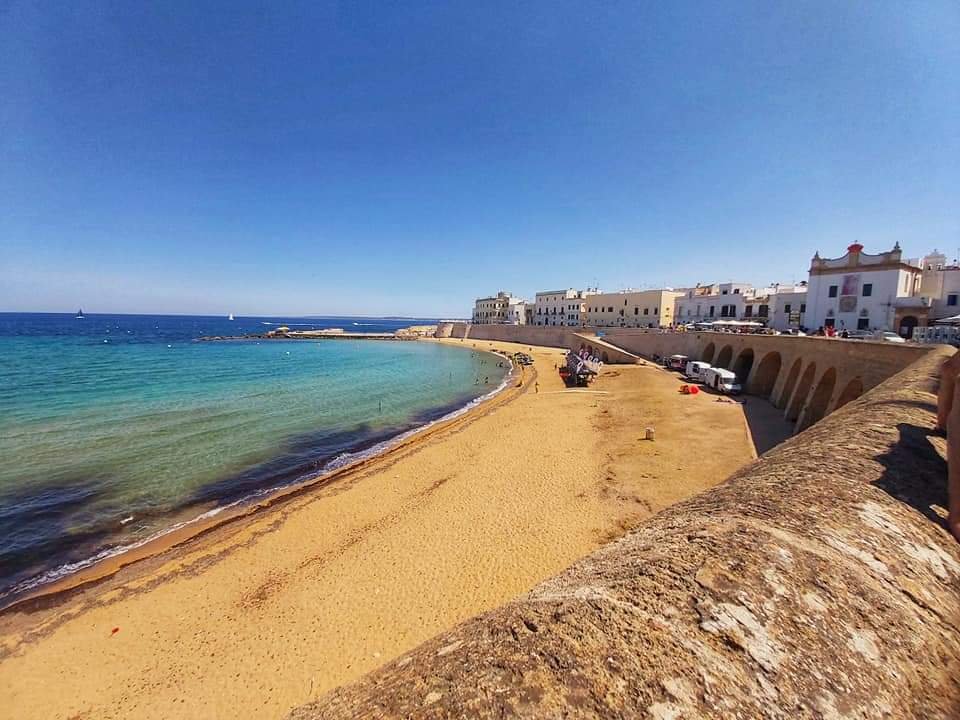
Right at the foot of the ramparts (opening photo), the Spiaggia della Purità is Gallipoli’s emblematic urban beach: fine sand and turquoise water two minutes’ walk from the historic centre — it is rare in Puglia to be able to swim so close to a listed old town.
Gallipoli’s fish market
At the entrance to the historic centre, on the harbour side, Gallipoli’s mercato ittico (fish market) is one of the most authentic free shows in town: from the early hours, fishermen sell their catch of the day directly, including the famous gamberi rossi (red prawns) and ricci di mare (sea urchins), which many people enjoy raw on the spot, standing up, with a squeeze of lemon. An essential stop for anyone interested in local food, even without buying anything.
What to eat in Gallipoli
Gallipoli draws directly on the produce of the Ionian Sea: raw fish and shellfish at the market, scapece gallipolina (small fried fish marinated in a saffron-and-vinegar breadcrumb coating, originally a method of preservation), pittule (savoury fritters) and polpo alla pignata (octopus slow-cooked in a terracotta pot). Local wines — negroamaro, primitivo, malvasia — go well with these seafood dishes.
For a complete tour of the regional classics, see our guide to the cuisine of Puglia.
How to get to Gallipoli
Gallipoli is about 40 minutes’ drive south-west of Lecce, and just under 2 hours from the airports of Bari or Brindisi (see our Bari or Brindisi comparison). Driving is the most practical way to combine the visit with the rest of Salento.
Without a car, Gallipoli station is served by Salento’s regional lines (Trainline, Trenitalia), and regional buses (Omio) serve the town from Lecce and the rest of Salento.
Traffic, ZTL and parking
Gallipoli’s historic centre is a ZTL zone, monitored by automatic cameras, with the main access via the Ponte Giovanni Paolo II at the entrance to the old town. Hours vary by season: access is restricted from 11 a.m. to midnight from 2 April to 31 May and from 1 to 31 October, and from 11 a.m. to 3 a.m. from 1 June to 30 September.
| Car park | Advantage |
|---|---|
| Via Venezia | Convenient, just before the bridge to the old town |
| Porto | Close to the harbour and the old town |
ZTL hours and rules can change: always check the signs at the entrance to the zone before parking, to avoid a fine.
How long to stay and when to come
Gallipoli can be seen in 2 to 3 hours for the essentials of the historic centre, or in half a day to a full day if you add the beach and a stop at the fish market. For a stay on site, allow at least 2 nights for a short break, and 3 to 4 nights to make the most of the town and its beaches.
Best time to visit: May-June and September, for pleasant weather and more reasonable crowds. July and August are very lively and very busy — this is also when Gallipoli’s nightlife (seafront bars and clubs) is in full swing, especially around Baia Verde.
As for events, the Carnevale di Gallipoli (February) is one of the best known in Puglia, and the Festa di Santa Cristina (24-25 July), for the town’s patron saint, brings together processions, festive lights and fireworks.
Our favourites around Gallipoli
Gallipoli combines naturally with its best-known beaches, a few minutes away by car:
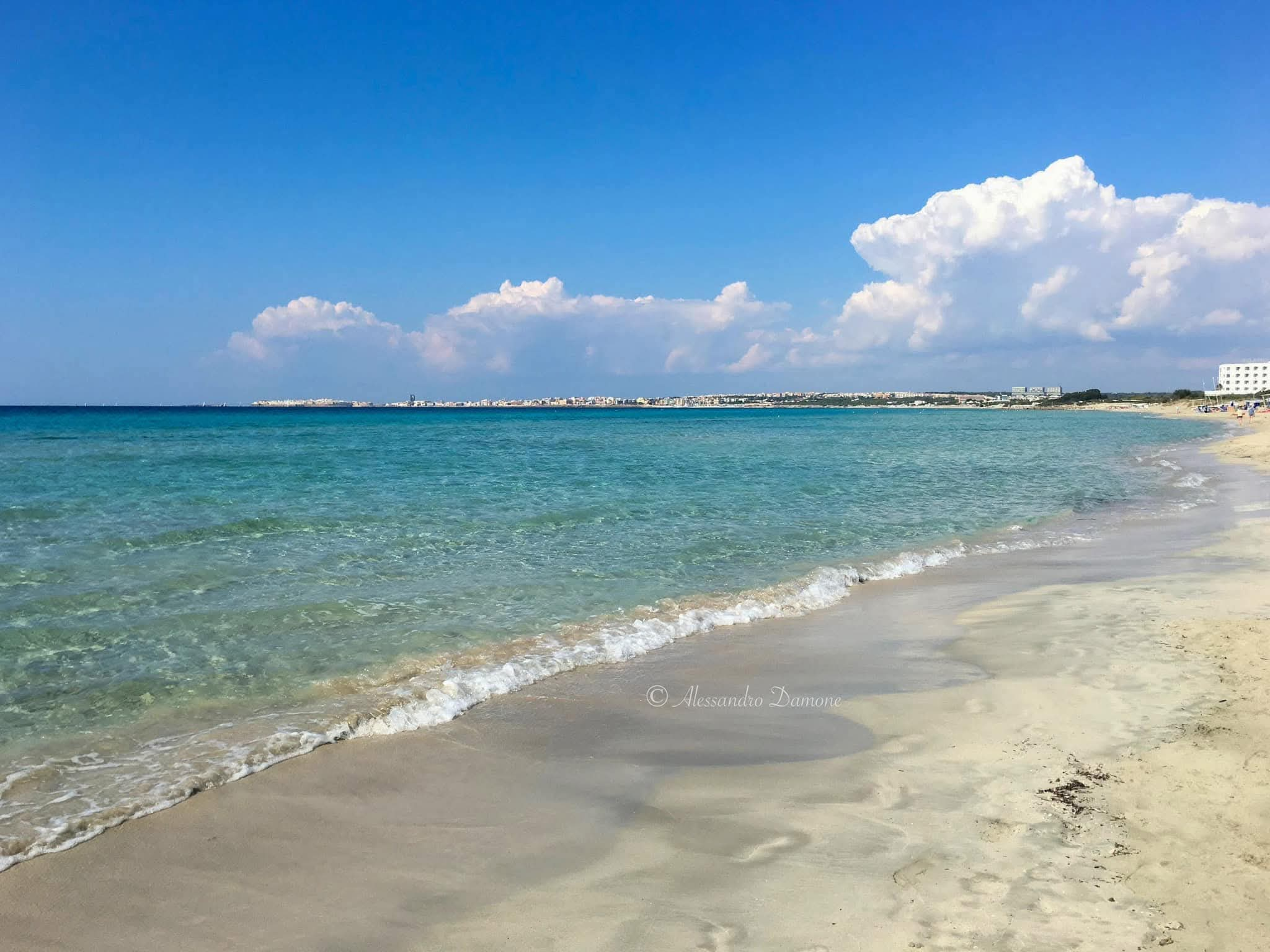
Baia Verde
Gallipoli’s festive, emblematic beach, with pale sand and lively beach bars in summer.
Discover →
Punta della Suina
Pines, turquoise water and sunsets: a wilder setting just a few minutes from Gallipoli.
Discover →For a wider selection, see our article on the most beautiful beaches in Puglia.
Where to stay in Gallipoli
Staying in the historic centre lets you enjoy the atmosphere of the old town early in the morning and in the evening, but accommodation there is often small and has no direct car access (because of the ZTL). For a quieter night in high season, it is better to stay away from the Baia Verde area, where nightlife can run late. For a wider choice of accommodation by area, see our guide where to stay in Puglia.
Mistakes to avoid
- Parking in the historic centre: the ZTL is monitored by cameras and the fine is automatic. Park before the bridge, at the Via Venezia or Porto car parks.
- Booking accommodation without checking how close it is to Baia Verde: nightlife there is intense from June to September, and less suited to a quiet family stay.
- Seeing only the Spiaggia della Purità: Baia Verde and Punta della Suina, a few minutes away, offer calmer, less crowded water.
- Coming in midsummer without booking: car parks and accommodation fill up quickly in July-August.
Plan your visit to Gallipoli with APULIA
Want to organise your visit to Gallipoli day by day, combine it with the rest of Salento and save your favourite places? The APULIA app builds a tailor-made itinerary based on your dates and wishes.
Looking for a stress-free stay between Gallipoli, Salento and the rest of Puglia?
Plan my stay with APULIAIn summary
Gallipoli deserves at least half a day in a Puglia itinerary: 2 to 3 hours for the fortified historic centre (Castello, Cattedrale, Fontana Greca), a stop at the fish market, and a little beach time at the Spiaggia della Purità or Baia Verde. Come in May-June or September for the best balance between weather and crowds, and continue to Punta della Suina for a quieter atmosphere.
Frequently asked questions
How long does it take to visit Gallipoli?
Allow 2 to 3 hours for the historic centre. With the beach and a stop at the fish market, plan on half a day to a full day.
When is the best time to visit Gallipoli?
May-June and September offer the best compromise between pleasant weather and moderate crowds. July-August are very lively, with a strong nightlife scene.
Is Gallipoli a noisy town in the evening in summer?
The Baia Verde area is home to very active seafront bars and clubs in summer. The historic centre is calmer, but still lively; for a quiet night, it is better to choose accommodation slightly away from the centre.
Where should I park to visit Gallipoli’s historic centre?
The centre is a ZTL zone monitored by cameras. Park before the bridge, at the Via Venezia or Porto car parks, then continue on foot.
What is the most beautiful beach near Gallipoli?
The Spiaggia della Purità, at the foot of the ramparts, is the most emblematic. Baia Verde (lively) and Punta della Suina (wilder) are a few minutes away by car.