
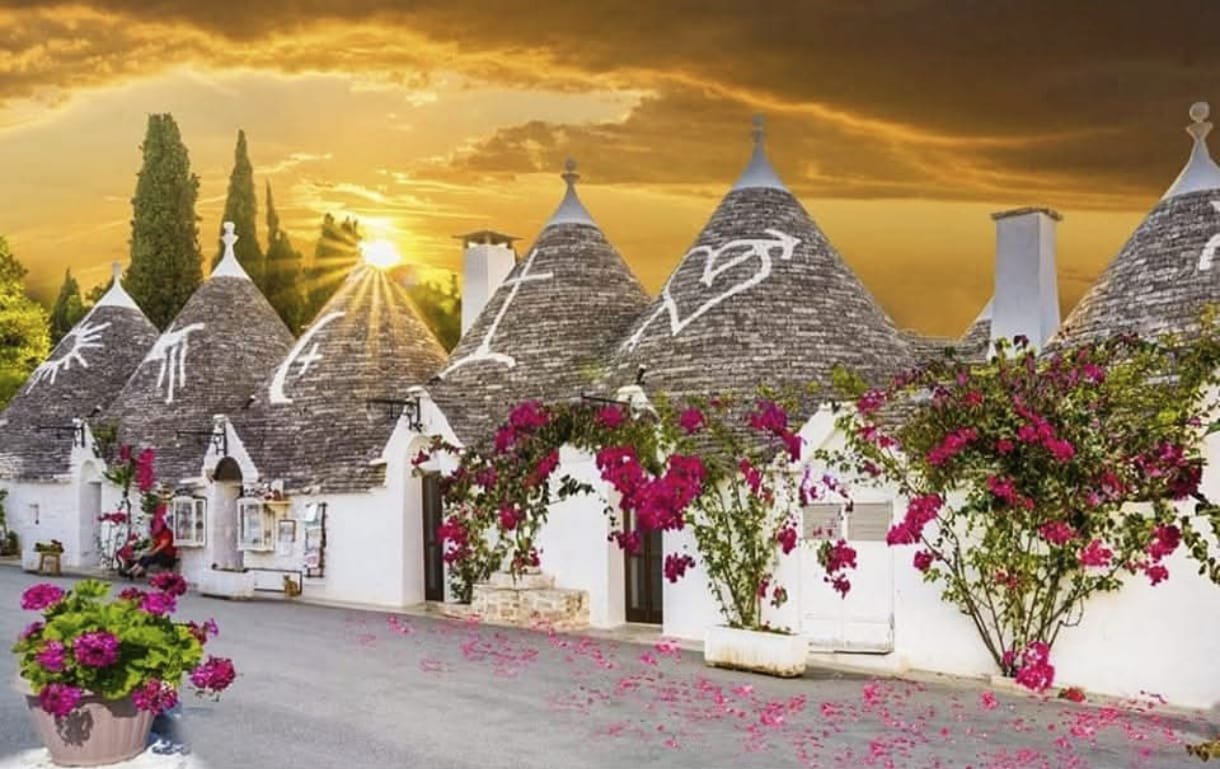
With its thousands of conical dry-stone houses, Alberobello is the most photographed village in Puglia and one of the most singular sights in Italy. Its trulli, a UNESCO World Heritage Site since 1996, tell a centuries-old story of feudal taxation, peasant resistance and architectural ingenuity.
From the lanes of the Rione Monti to the still-inhabited trulli of the Aia Piccola and the two-storey Trullo Sovrano, here is everything you need to know to visit Alberobello without settling for a postcard snapshot.
QUICK ANSWER
- Top sights: the Rione Monti (the district with the most trulli), the Aia Piccola (more authentic) and the Trullo Sovrano, the only two-storey trullo.
- Recommended time: 2 to 3 hours for the essentials, half a day if you want to take your time and visit a museum.
- Best time: before 9am or after 5pm to avoid the tour buses; April to June and September to October for pleasant weather.
- Getting there: about 1 hour’s drive from Bari; the historic centre is a ZTL zone, so park at the Via Indipendenza or Largo Martellotta car parks.
Contents
- Alberobello in a few words
- The trulli of Alberobello: history and legend
- What to see in Alberobello: the must-sees
- What to eat in Alberobello
- How to get to Alberobello
- Traffic, ZTL and car parks
- How long to stay and when to come
- Our favourites around Alberobello
- Sleeping in a trullo in Alberobello
- Mistakes to avoid
- Frequently asked questions
Alberobello in a few words
Alberobello is a small town in the Itria Valley, in the province of Bari, built almost entirely of trulli — those conical limestone dwellings, built without mortar, found nowhere else in the world. Two districts hold most of this heritage: the Rione Monti, with around 1,030 trulli, and the Aia Piccola, with nearly 590 — more than 1,600 structures in total, listed as UNESCO World Heritage since 1996.
Unlike other villages in Puglia where trulli are only the occasional sight, here the entire historic centre is made of them, which makes for a visit like no other: you literally stroll inside the listed site.
The trulli of Alberobello: history and legend
The distinctive shape of the trulli is not just an aesthetic choice: it comes from a story of feudal taxation. From the mid-14th century until the end of the 18th, Alberobello was under the control of the Acquaviva d’Aragona counts, lords of Conversano. To escape a royal tax on permanent buildings, the counts are said to have required their peasants to build dry-stone dwellings without mortar: if the king’s inspectors came, the roofs could be quickly dismantled, making the evidence of an established “village” disappear.
This state of affairs lasted until 27 May 1797, when King Ferdinand IV of Bourbon, following a petition from the inhabitants, granted Alberobello the status of a free royal town, ending the Acquaviva family’s feudal tutelage. A symbol of this liberation: the Casa d’Amore, built the same year, is the first building in the village erected with mortar and a conventional tiled roof rather than a stone cone — a gesture of emancipation still visible today in the Rione Monti.
The dry-stone building technique (without mortar), with limestone slabs cut and corbelled to form the conical roof, is a prehistoric method still used in the region today — it is this, as much as the tax legend, that justifies the UNESCO listing.
What to see in Alberobello: the must-sees

The Rione Monti is the most photographed district: its sloping lanes have the highest density of trulli, now largely converted into craft and souvenir shops. This is also where you will find the Chiesa di Sant’Antonio, a church built in the shape of a trullo itself — climbing up to it, in the upper part of the district, gives you an overview of the conical roofs.

On the other side of Via Indipendenza, the Aia Piccola has a very different atmosphere: fewer shops, more residents, and a good chance to see what everyday life in a trullo is really like. It is the best place for photos without the crowds of the Rione Monti.

The Trullo Sovrano, on Via Curtopassi, is the only two-storey trullo in the whole village: built in the 18th century by a well-off family, it can be visited as a period-furnished house museum for an entrance fee of just a few euros. It is the most interesting stop for understanding the inside of these dwellings, beyond the façade.
What to eat in Alberobello
Alberobello is not especially known for a specialty of its own, but it benefits from the cooking of the whole Itria Valley: fresh orecchiette, fave e cicorie, burrata and caciocavallo from the local dairies, and a good selection of regional wines (primitivo, negroamaro). The restaurants of the Rione Monti are convenient but touristy; for a more authentic address, it is better to walk a few streets away from the historic centre.
For a complete tour of the regional classics, see our guide to the food of Puglia.
How to get to Alberobello
Alberobello is about 1 hour’s drive south of Bari, and around forty minutes from Monopoli or Polignano a Mare. Driving is the most practical way to combine the visit with the neighbouring villages of the Itria Valley.
Without a car, the FSE (Ferrovie del Sud Est) railway line links Bari to Alberobello in about 1h20, with a station roughly ten minutes’ walk from the Rione Monti.
Traffic, ZTL and car parks
Alberobello’s historic centre is a ZTL zone (limited traffic), in force all year round and monitored by cameras. It is better to leave your car in one of the car parks on the outskirts than to risk a fine.
| Car park | Advantage |
|---|---|
| Via Indipendenza | Official visitor car park, a 5-10 minute walk from the centre |
| Largo Martellotta | Central car park, convenient outside high season |
ZTL rules and hours can change: always check the signs at the entrance to the zone before you park.
How long to stay and when to come
Alberobello can be visited in 2 to 3 hours for the essentials (Rione Monti and Aia Piccola on foot), or in half a day to a full day if you add the Trullo Sovrano and lunch in town. Spending a night there lets you enjoy the village early in the morning or at the end of the day, once the tour buses have left.
Best season: April to June and September to October, for pleasant weather and more manageable crowds than in high summer. Between 10am and 4pm in high season, the Rione Monti can get very busy.
Our favourites around Alberobello
Alberobello combines naturally with the other villages of the Itria Valley, less than 20 minutes away by car:

Locorotondo
A circular village of white houses and pointed roofs, one of the most photogenic and least crowded in the area.
Discover →
Cisternino
One of the best-preserved historic centres in Puglia, known for its bracerie where you pick your meat at the counter.
Discover →For a wider selection of villages across the whole region, see our article on the most beautiful villages in Puglia.
Sleeping in a trullo in Alberobello
Sleeping in a real trullo, in a guest room or as a whole-house rental, is an experience in itself and in high demand in high season: it is best to book several weeks ahead in summer. The trulli in the historic centre are often small and have no car access right nearby (because of the ZTL) — for more comfort and easy access by car, some people prefer to stay in a trullo on the outskirts or in a masseria in the surrounding countryside.
Mistakes to avoid
- Coming in the middle of a summer day: between 11am and 4pm in July and August, the lanes of the Rione Monti are packed and the heat on the white stone is intense.
- Parking in the historic centre: the ZTL is monitored by cameras, and the fine is automatic.
- Visiting only the Rione Monti: the Aia Piccola, right next door, is far less crowded and shows a more authentic side of the village.
- Eating on the main shopping street without comparing: prices and quality vary widely between places aimed at passing tourist trade and those a little further out.
Plan your visit to Alberobello with APULIA
Want to plan your visit to Alberobello day by day, combine it with the Itria Valley and save your favourite spots? The APULIA app builds a tailor-made itinerary based on your dates and your wishes.
Looking for a hassle-free stay in the Itria Valley and Puglia?
Plan my stay with APULIAIn short
Alberobello deserves at least half a day on any Puglia itinerary: 2 to 3 hours for the Rione Monti and the Aia Piccola, a little longer to visit the Trullo Sovrano and have lunch in town. Come early in the morning or at the end of the day to avoid the tour buses, and combine the visit with Locorotondo and Cisternino to make the most of the Itria Valley.
Frequently asked questions
How long does it take to visit Alberobello?
Allow 2 to 3 hours to see the essentials of the Rione Monti and the Aia Piccola. With a visit to the Trullo Sovrano and lunch in town, plan for half a day.
What is the best time of year to visit Alberobello?
April to June and September to October offer the best compromise between pleasant weather and moderate crowds. Come before 9am or after 5pm in high season to avoid the tour buses.
Why do trulli have a conical shape and no mortar?
According to local tradition, the counts of Conversano are said to have imposed this dismantlable form of construction on their peasants to escape a royal tax on permanent dwellings, until Alberobello gained its freedom in 1797.
Can you sleep in a trullo in Alberobello?
Yes, many trulli in the centre and the surrounding area can be rented as guest rooms or as whole-house rentals. Book several weeks ahead in summer, as demand is high. See our guide to sleeping in a trullo in Puglia to compare the options in town and in the countryside.
Do you need a car to visit Alberobello?
The village can be explored entirely on foot, but a car is useful for combining the visit with Locorotondo, Cisternino and the rest of the Itria Valley. Beware of the ZTL in the historic centre, where you must not park.