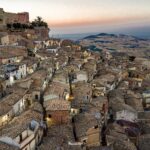
Castello di Sant'Agata di Puglia
Imperial fortress of Lombard-Byzantine origin, designated a Swabian stronghold by Frederick II in 1239, transformed over the centuries into a residential palace.
Voir sur la carte ›Les informations utiles à connaître avant ta visite.

🅿️ Parking
The historic center can be visited on foot. Park on the outskirts of the center and follow local signage (free or paid parking depending on the zones).
ℹ️ No ZTL was found in the sources consulted online; the municipality's website could not be accessed by our tools. This does not prove that one does not exist. ℹ️ Temporary closures may be decided during festivals, markets, or roadworks: always check the signage at the entrance to the historic center.
Mattinata (Gargano)
Distance : 104000
Médiévale, panoramique, calme
Exceptional views over the Tavoliere and Basilicata, remarkable medieval military architecture, Slow Food and Orange Flag recognition
Information non renseignée pour le moment.
Visit the castle, stroll through the medieval center, and discover the former Convento delle Vergini.
1 to 2 h — Quick visit | 3 to 4 h — Recommended visit | Half-day — Full visit
Les informations utiles pour organiser ton arrivée, tes déplacements et ton stationnement autour de cette destination.
From Foggia, allow about 55 minutes (49 km).
No train station in Sant’Agata di Puglia: the nearest station is Candela-Sant’Agata di Puglia (Trenitalia, connections to Foggia and Potenza), with limited bus connections to the village.
Hours & tickets:
Trenitalia
Buses connect Sant’Agata di Puglia to Foggia (about three departures per day, approx. 1 hour journey). See lines
Sant’Agata di Puglia stands at 794 m above sea level, between the Calaggio and Frugno streams in the Monti Dauni. It is called the “loggia delle Puglie” for its wide-open views. Its castle, of Lombard origin, restored by the Normans and then reinforced by the Swabians and Angevins, overlooks the village. You walk through the medieval center, then look out over the plain from the high points. The village received the Touring Club’s Orange Flag in 2002 and Slow Food recognition in 2016.


Les informations pratiques pour organiser ta visite.
Consulte la carte des bornes de recharge disponibles autour de cette destination.
Voir les bornes de recharge🅿️ Parking
The historic center can be visited on foot. Park on the outskirts of the center and follow local signage (free or paid parking depending on the zones).
ℹ️ No ZTL was found in the sources consulted online; the municipality's website could not be accessed by our tools. This does not prove that one does not exist. ℹ️ Temporary closures may be decided during festivals, markets, or roadworks: always check the signage at the entrance to the historic center.
Mattinata (Gargano)
Distance : 104000
Médiévale, panoramique, calme
Exceptional views over the Tavoliere and Basilicata, remarkable medieval military architecture, Slow Food and Orange Flag recognition
Information non renseignée pour le moment.
Visit the castle, stroll through the medieval center, and discover the former Convento delle Vergini.
1 to 2 h — Quick visit | 3 to 4 h — Recommended visit | Half-day — Full visit
From Foggia, allow about 55 minutes (49 km).
No train station in Sant’Agata di Puglia: the nearest station is Candela-Sant’Agata di Puglia (Trenitalia, connections to Foggia and Potenza), with limited bus connections to the village.
Hours & tickets:
Trenitalia
Buses connect Sant’Agata di Puglia to Foggia (about three departures per day, approx. 1 hour journey). See lines
Ajoute tes favoris et construis ton itinéraire avec APULIA.
Créer mon séjour

Imperial fortress of Lombard-Byzantine origin, designated a Swabian stronghold by Frederick II in 1239, transformed over the centuries into a residential palace.
Medieval urban fabric with a spiral layout, characterized by narrow alleys, steep staircases, arches, and towers.
Double fortified walls restored by successive lords, with the second wall protecting the citadel via the Porta Nuova.
Former convent now converted into a hotel and museum, a testament to the village's rich religious heritage with its three historic convents.